


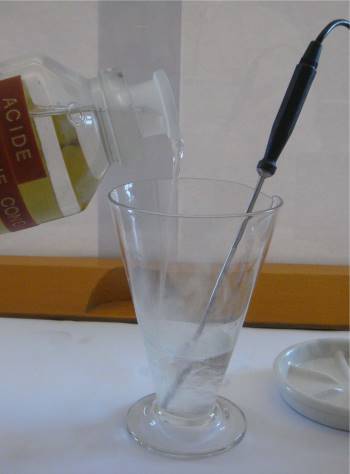
Chlorhydric acid $H^{+}$ $+$ $Cl^-$ is poured into a solution of sodium hydroxide $Na^{+}$ $+$ $OH^{-}$. An important heat production is observed which is caused by the production of water resulting from neutralisation of hydroxyde ions with hydrogen ions. $H^{+}$ $+$ $OH^{-}$ $\longrightarrow$ $H_2O$ Adding the "spectator" ions( which do not react ) we have: $H^{+}$ $+$ $Cl^-$ $+$ $Na^+$ $+$ $OH^-$ $\longrightarrow$ $H_2O$ $+$ $Na^{+}$ $+$ $Cl^-$ The resulting solution of common salt (sodium chloride) is colourless.
When an acid and an hydroxide (base) are added, $H^+$ and $OH^-$ neutralise themselves mutually and produce water: $H^{+}$ $+$ $OH^{-}$ $\longrightarrow$ $H_2O$ The "spectator" ions, according to solubility rules, either stay in solution or associate to ionic solid lattices.