


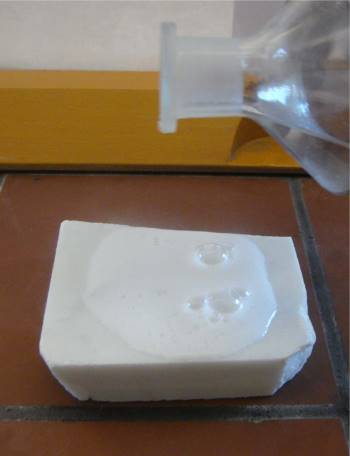
Diluted chlorhydric acid $H^{+}$ $+$ $Cl^-$ is poured on a marble $Ca^{2+}CO_3^{2-}(s)$ plate. Very unstable carbonic acid is produced, which decomposes into water and carbon dioxide(gas): $2H^{+}$ $+$ $CO_3^{2-}$ $\longrightarrow$ $CO_2(g)$ $+$ $H_2O$ Adding the "spectator" ions( which do not react ) we have: $2H^{+}$ $+$ $Cl^-$ $+$ $Ca^{2+}CO_3^{2-}(s)$ $\longrightarrow$ $CO_2(g)$ $+$ $H_2O$ $+$ $Ca^{2+}$ $+$ $2Cl^-$ A carbon dioxide gas development is observed ( colourless gas which extinguishes the flame ) and a ( colourless ) solution of calcium chloride is produced.
An acid and a carbonate liberate carbon dioxide(g): $2H^{+}$ $+$ $CO_3^{2-}$ $\longrightarrow$ $CO_2(g)$ $+$ $H_2O$ An acid and a sulfite liberate sulfur dioxide(g): $2H^{+}$ $+$ $SO_3^{2-}$ $\longrightarrow$ $SO_2(g)$ $+$ $H_2O$ An acid and a sulfide liberate hydrogen sulfide(g): $2H^{+}$ $+$ $S^{2-}$ $\longrightarrow$ $H_2S(g)$